
Yesterday, Governor Whitmer presented her executive budget to legislators and the public. While there’s a lot in there, we’re focused on what the Governor had to say on transit – and overall, while this budget is a good step forward, it is not enough to deliver great transit for Michigan. As a reminder, this is only the first budget proposal for FY2027, and is not enacted into law – we’re just getting started on budget season. Additionally, check out our webpost on how Michigan funds transit if you want a high level refresher.
Why is the budget important?
Every year, TRU pays a lot of attention to the state budget because more than a quarter of local bus expenses statewide are paid for with state support. That state transit spending directly impacts how frequent buses run, how long seniors have to wait for rides, and whether we can get across the state in reasonable time. Additionally, transit has countless benefits for our state. Transit is important for helping our aging population, attracting young people and families, and addressing affordability concerns – all priority areas identified by Governor Whitmer.
We start off with some major changes for transportation funding, as this is the first full year of new transportation revenue, from the roads deal from last year. As a reminder, this funding package is expected to provide $1.6 billion a year for MDOT, with 69% going to local roads, and 10% going to transit – and we fought hard for that 10%. This year, MDOT received a total budget of $8.5 billion. While most of this goes to roads, a decent chunk is going to transit.
Local Bus Operating (LBO) starts with a small win
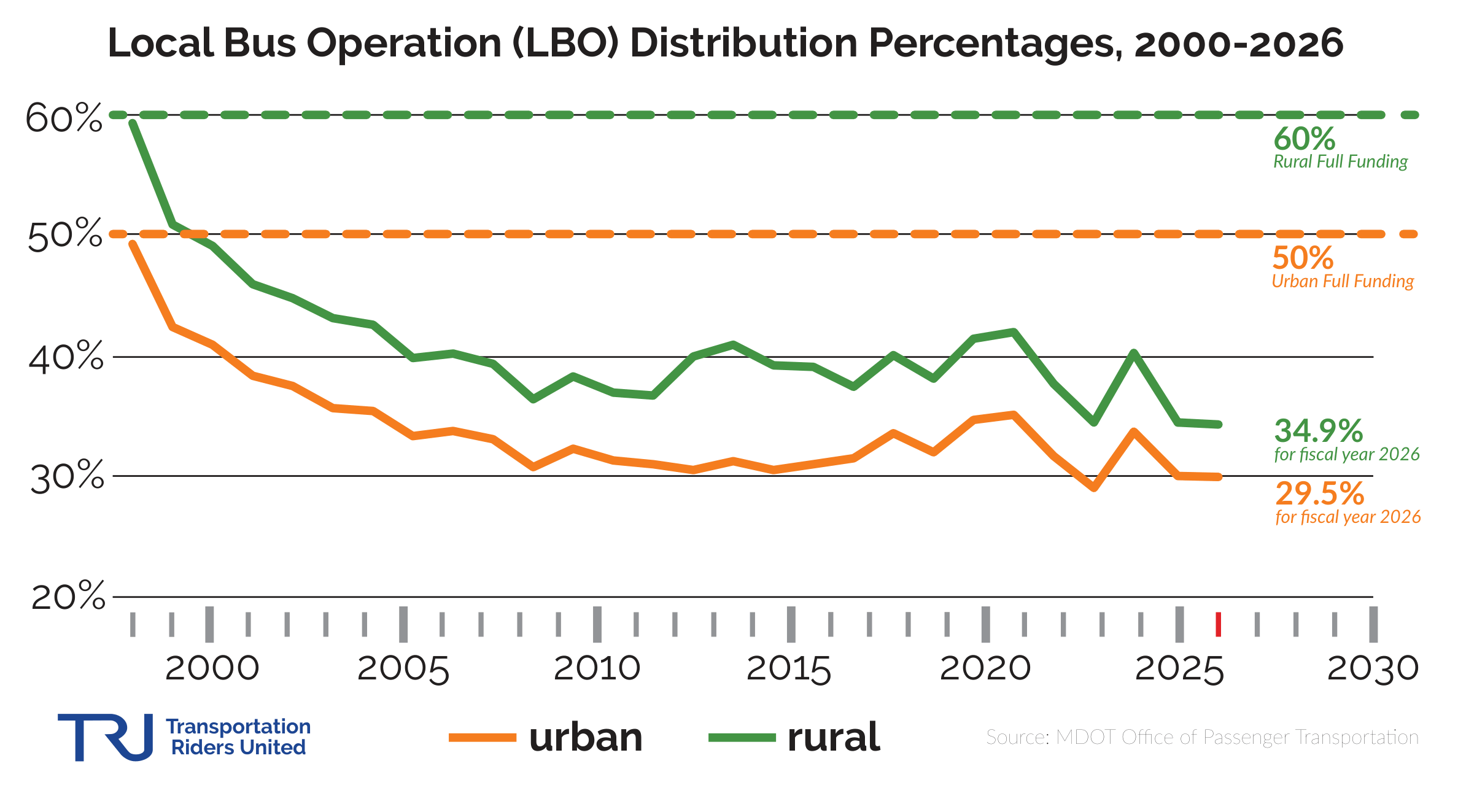
LBO will receive a $43.4M increase, bringing total LBO funding to $315M in total, up from $271M last year. This would result in a roughly 2% increase in the reimbursement rate for Michigan’s 82 transit agencies, resulting in a small increase for agencies. While this small increase is good (and brings our transit agencies out of financial crisis), we need to stay ahead of rising costs and make sure the reimbursement rate doesn’t decline if Wayne County goes all-in on transit. We’re calling for LBO funding to be raised to $330M by the Legislature.
Intercity Bus funding remains minuscule
Intercity bus saw a minuscule increase of $600K, bringing the total amount to $10.8M. This money is used to provide capital funding for new buses along I-94, I-96, and the Up North Indian Trails routes; along with operational support for all five bus routes North of Grand Rapids, Lansing, and Bay City. If we want true Cross-State bus service between Michigan’s cities, this needs to grow must faster. Intercity Bus should receive $20M a year to get the investment it needs.
No major changes on rail funding
While a glance at the budget for Office of Rail shows a big increase to $219M, up from $149M last year, that increase is all federal funds for the Livernois Yard freight project in Detroit. All rail operations has seen no major changes, and Rail only received directly an additional $100K for staff.
However, there is some increased rail capital projects funding, which is not part of the rail line item, but is instead included in a new line item called:
Intermodal Capital Funding Changes & Increase
It may appear that numerous capital funding line items have been removed: This is because capital rail, public transit, marine, and aeronautical programs were all rolled into the Intermodal Capital Fund, which allows MDOT greater flexibility in how and when these dollars are spent. This amount is about $300M – and includes an increase in funding despite the consolidation of multiple pools into one.
Additionally, the $65M Infrastructure Projects Authority Fund (IPAF) enacted last year (aka the Transformational Transit Fund) will begin accepting applicants and receive the funds promised last year. This program is open for local transit authorities and municipalities (cities and counties) to apply for funding. MDOT’s Office of Passenger Transportation (OPT), who oversees public transit and intercity bus projects, received funding for four full time employees (FTE) to administer the program and support their efforts.
Specific Projects
While it’s federal money, MDOT has received $70M for the new multimodal bus and train station near Michigan Central in Detroit, which is included in this budget. Additionally, there’s $40M for railroad grade separation – however, it’s highly likely most of this money will be going to grade separation of freight railroads Downriver.
Where do we go from here?
Overall, this budget is a good step forward – but is not enough. We’re calling on the legislature to:
- Invest $330M in LBO (up from $315M in the proposed budget) to allow for 4% growth for agencies.
- Invest $20M in Intercity Bus (up from $10.8M) to allow for expanded intercity bus service, including Up North and between Michigan’s major cities.
Please take a moment to write to your legislators about the importance of transit funding.