
TRU works hard to make transit better across our entire state. Learn more about what we’re currently doing to improve local and cross-state transit in Michigan!
State Budget
TRU is fighting to increase transit funding in the Michigan state budget.
For years, the amount of funding the state gives transit agencies to operate buses (Local Bus Operation, or LBO) has been declining. While the state used to provide near the full 60% of local bus operations for rural agencies, and 50% for urban, this has decreased over the decades to half of full funding.
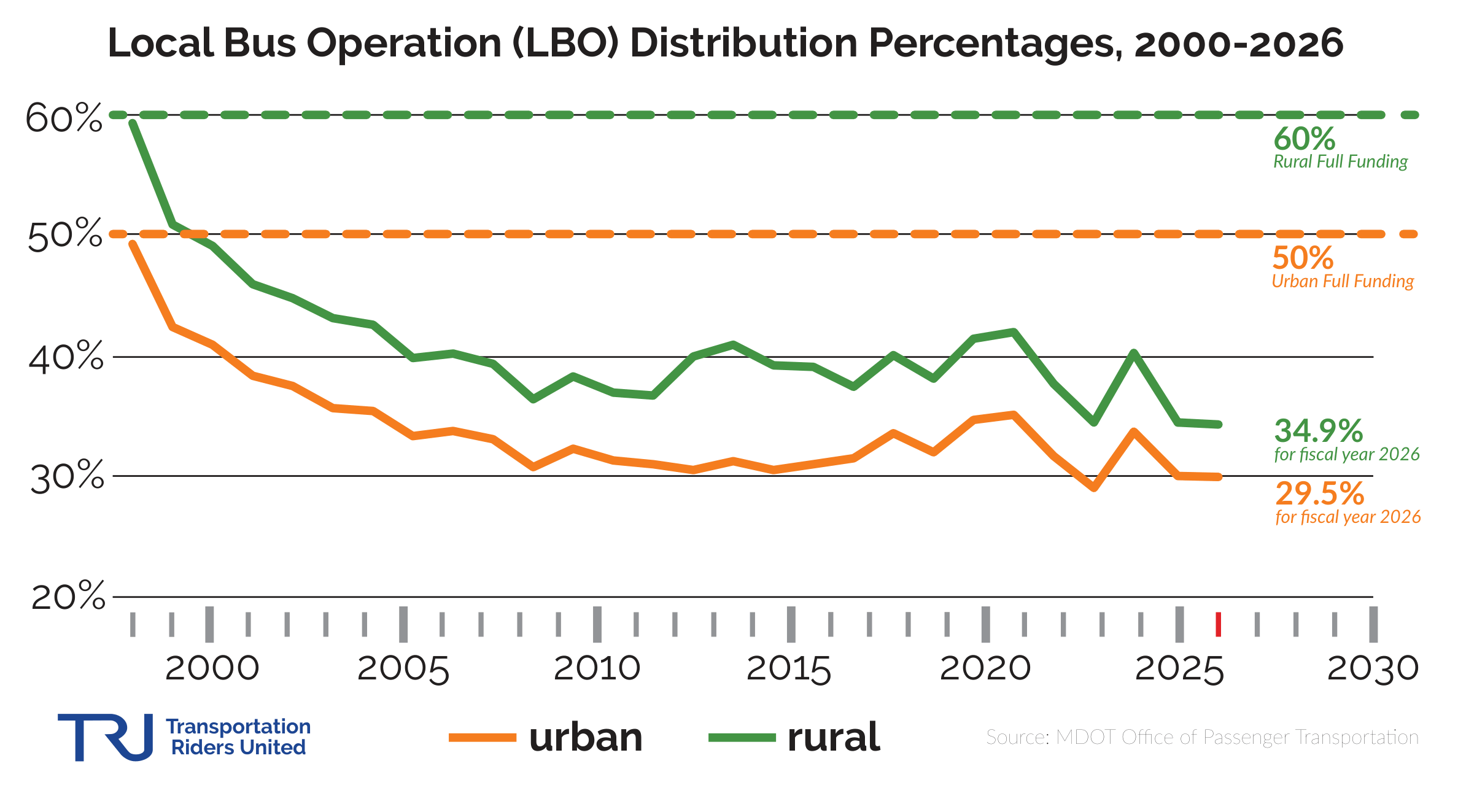
FY27 Budget Update: The FY27 budget brings LBO funding to nearly $305M – up from $276M in 2026, and up from $226M in FY25, and includes allocating the promised $65M for transformational transit projects. Read more here. Next year, we’ll be pushing for a further increase after the disappointing, only inflation matching increase we saw this year
If Michigan wants a truly great transportation system, we need to double state funding for transit.
We need to restore full LBO funding ($440M in FY26), and invest $300M a year into rail, intercity bus, senior services, and ferries.
How does Michigan fund Transportation?
Transportation funding in Michigan is complicated. There are many different pots of money and funding sources.
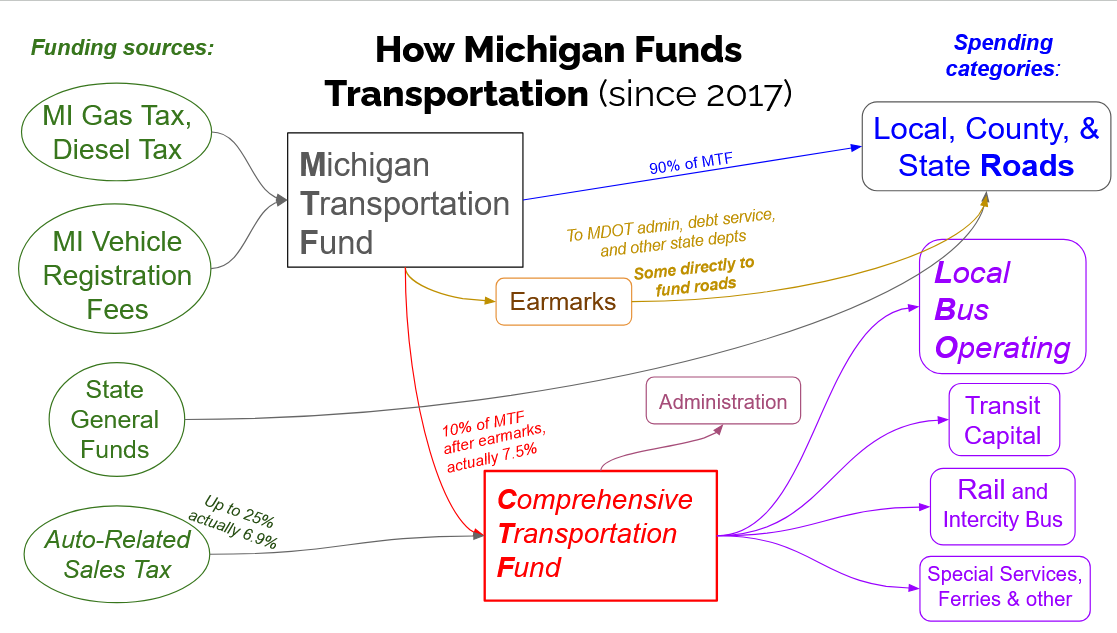
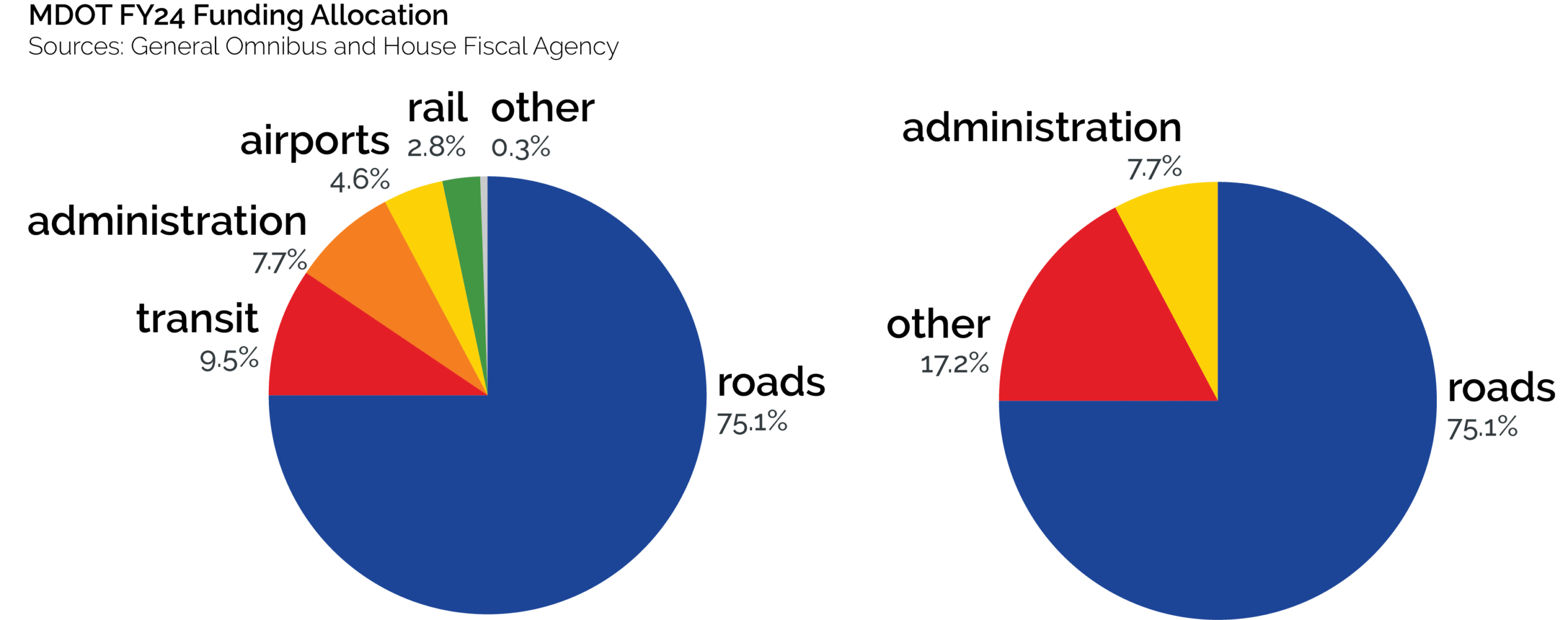
Transit and all non-roads transportation are currently funded by 6.9% of the Auto-Related Sales Tax, and 7.5% of the Michigan Transportation Fund (MTF). This money is pooled into the Comprehensive Transportation Fund (CTF). The CTF is the source for LBO, transit capita, rail and intercity bus, and special services like ferries, senior services, and other transportation modes.
In contrast, roads are funded by countless sources: 90% of the MTF goes to roads, and the MTF is funded by the state gas tax, diesel tax, and vehicle registration fees. Another 2.5% of MTF funds is earmarked, with some of this going to fund roads. No current earmarks go to fund transit.
Public Act 51 (PA51) of 1951 established the MTF and the CTF. This act calls for 10% of the MTF to be transferred to the CTF – much higher than the 7.5% the CTF actually gets. This percentage has also decreased in recent years – while previously stagnant near 8.5%, since 2018 this has declined to the current 7.5%.
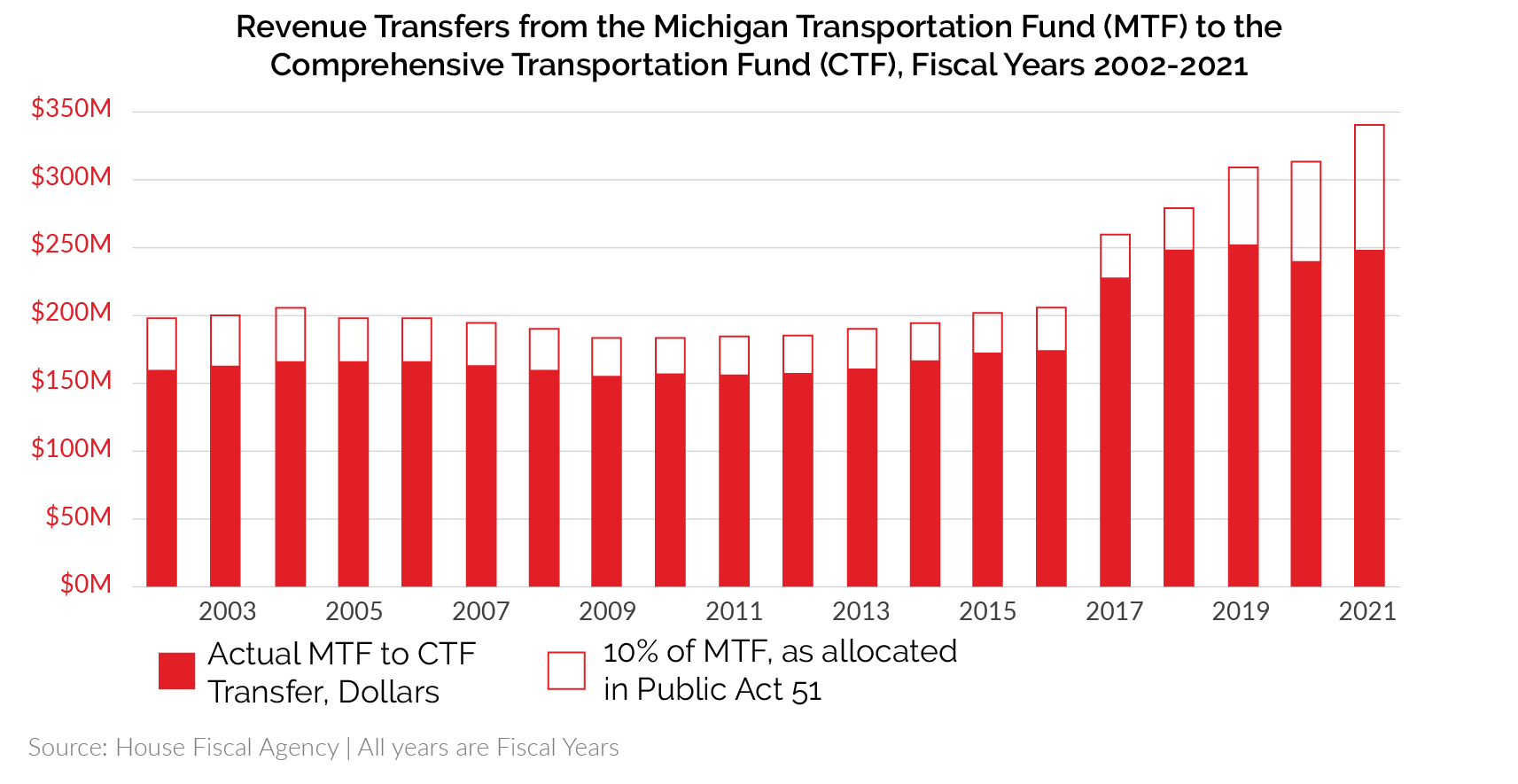
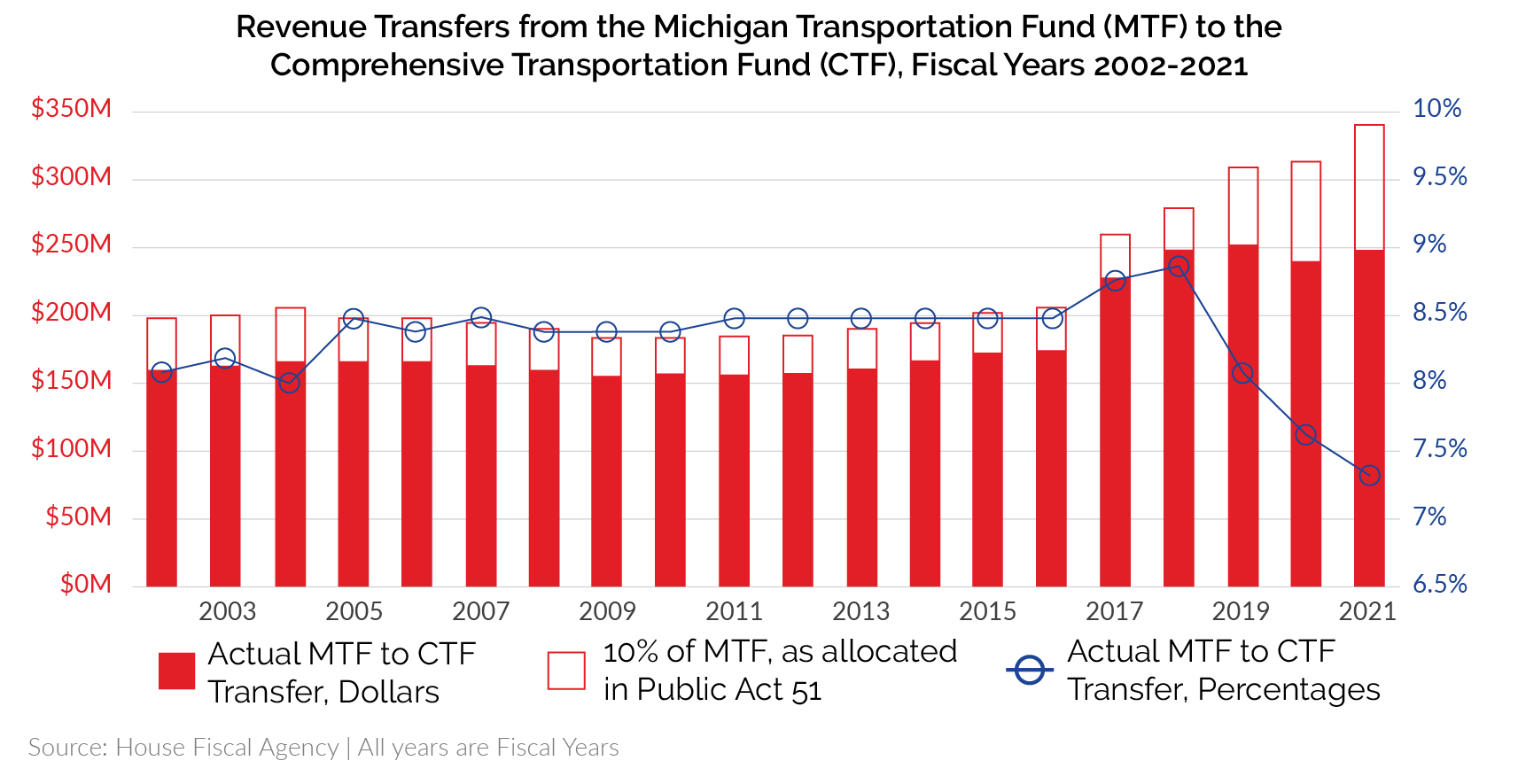
Additionally, transit can receive up to 25% of auto-related sales tax… but only receives 6.9%. If we allocated the full 25% of auto-related sales tax and the 10% of the MTF to CTF transfer, we could fully fund LBO this year.
Improving Cross-State (Intercity) Transit
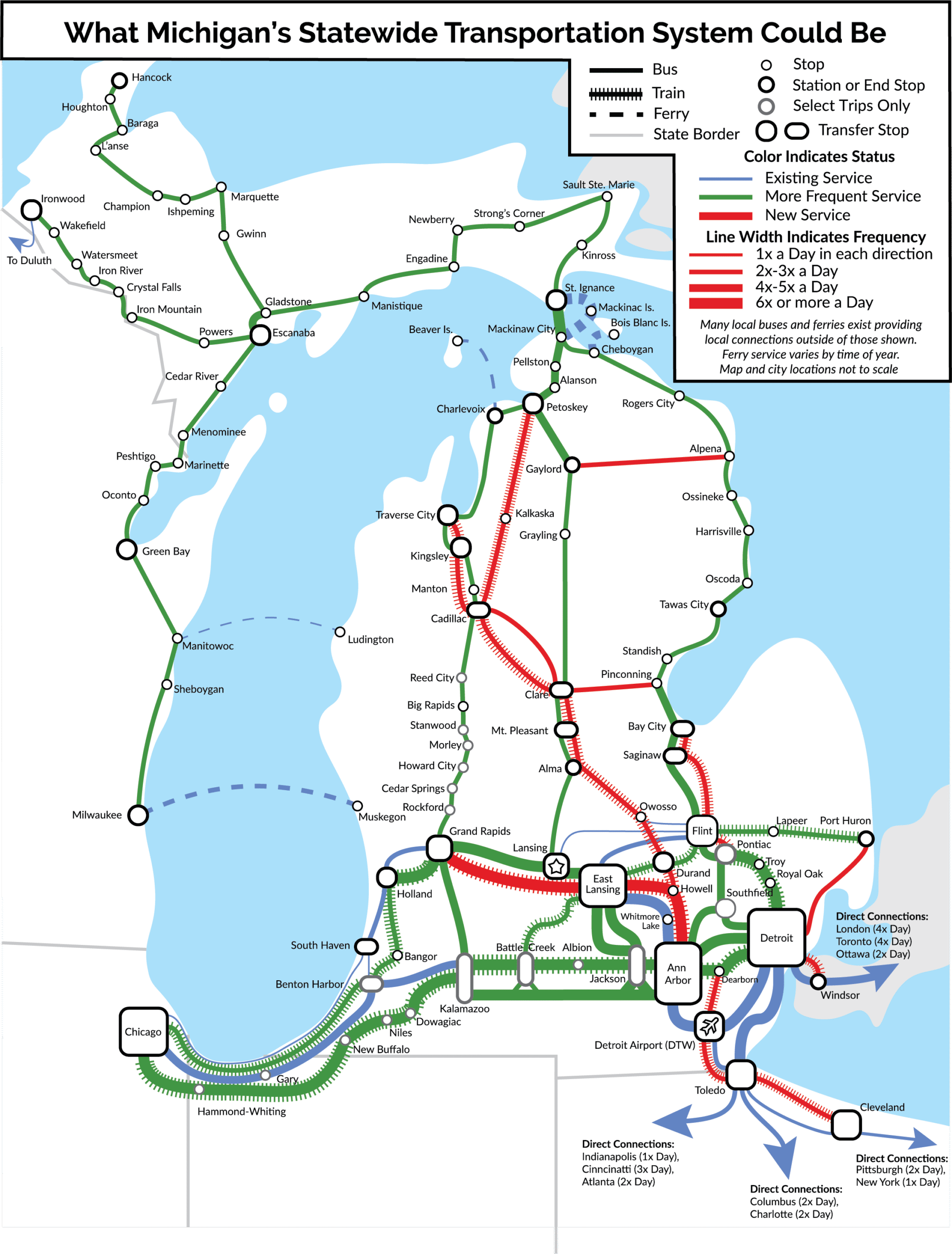
Imagine taking a train ride from downtown Detroit to Grand Rapids, without the hassle of driving. Imagine a fast, frequent bus connecting Grand Rapids and Kalamazoo. Or what if you could take a train Up North and avoid the Summer traffic? Michigan deserves a world-class transit system across our entire state, and the state can make that happen by investing in cross-state transit. Read more about our vision in our cross-state transit report.
Our lives don’t exist in one metro region or city, and while transit has broadly been improving across Michigan’s cities, intercity connections remain sparse, infrequent, and prone to delays. We’re pushing the state government to invest in improving Amtrak service and intercity bus service, including:
- New train service connecting Grand Rapids-Lansing-Detroit, Petoskey/Traverse City and Detroit, and seamless Chicago-Detroit-Toronto train service
- While new Amtrak investments are in progress, run Grand Rapids-Lansing-Detroit and Petoskey/Traverse City to Detroit inter city bus service, with at least 8 round trips a day.
- Improved reliability, speed, and frquency on existing Amtrak routes
- New regional and cross-state bus service, including Kalamazoo to Grand Rapids and East-West Up North connections
- More frequent cross-state bus service across Up North and downstate
Modernizing MDOT
The Michigan Department of Transportation (MDOT) has a lot of discretion in these funding decisions. In addition to our legislative budget efforts, we’re aiming to reform MDOT into a modern department of transportation that invests in people, not just pavement.
MDOT should prioritize safety, access, and the environment in selecting transportation projects. A truly modern MDOT is one that has a mode neutral project selection process, invest in multimodal transportation, and can quantify and increase transit access and quality across Michigan.
Move MI Transportation Alliance
TRU is partnering up with like-minded groups all across Michigan to build a powerful statewide network that will work together to reform Michigan’s transportation. Join Move MI Transportation Alliance!
We’re bringing clean transportation advocates together to advocate for:
- Transparent transportation decisions that prioritize health, access, and affordability for all Michiganders;
- More and better public transit and passenger rail services;
- Equitable expansion of electric vehicle infrastructure and access;
- Safer biking infrastructure and more walkable communities.
In addition to those transportation policy focused efforts, we’re advocating to:
- Reduce barriers to active transportation like offering e-bike incentives and implementing robust Complete Streets plans
- Eliminate parking minimums
- Increase Transit-Orientated Development (TOD)
- Make strategic investments to accelerate adoption of electric vehicles, offer electric car-share, and ensure access to convenient charging options
What Can You Do?
Join TRU! We rely on the support and participation of everyday people to make transit better in our city. We are a grassroots advocacy group, and we build power by uniting together. Become a TRU member, come to our next volunteer meeting, and join our volunteer list to help us improve transit across our state.